
Before there were pet food brands, before there were veterinary nutritionists writing feeding guidelines, before there was a “premium” dog food category- dogs ate. There was really a ancestral dog diet that is a world away from the supermarket aisle-pet food that it has now come to.
They ate what was available. They ate from human tables and village kitchens. They scavenged, hunted, and were fed scraps that would be recognisable to any cook: meat and bones, cooked grains, eggs, fish, whatever fat was going spare. Across thousands of years of co-existence with humans, this is what dogs ate. And their bodies adapted accordingly.
Understanding this history isn’t nostalgia. It’s the most useful guide we have for feeding dogs well today.
The Dog’s Evolutionary Story
The domestic dog (Canis lupus familiaris) diverged from wolves somewhere between 15,000 and 40,000 years ago — the exact timing is still debated, but the location and context aren’t. Dogs domesticated alongside humans. Their story is inseparable from ours.
What this means nutritionally is significant. Unlike wild wolves, who are primarily carnivores, domestic dogs evolved in environments where human food was abundant and varied. Research published in Nature in 2013 found that domestic dogs carry multiple copies of the gene responsible for digesting starch — an adaptation that wolves lack and that dogs developed specifically in response to thousands of years of eating alongside grain-farming humans.
In other words, dogs are not wolves with a collar. They are a distinct species, shaped by millennia with a ancestral dog diet of eating what humans eat: a varied diet including proteins, carbohydrates, fats, and vegetables, in proportions that reflect real food rather than a laboratory formulation.
The Indian Dog’s Particular History
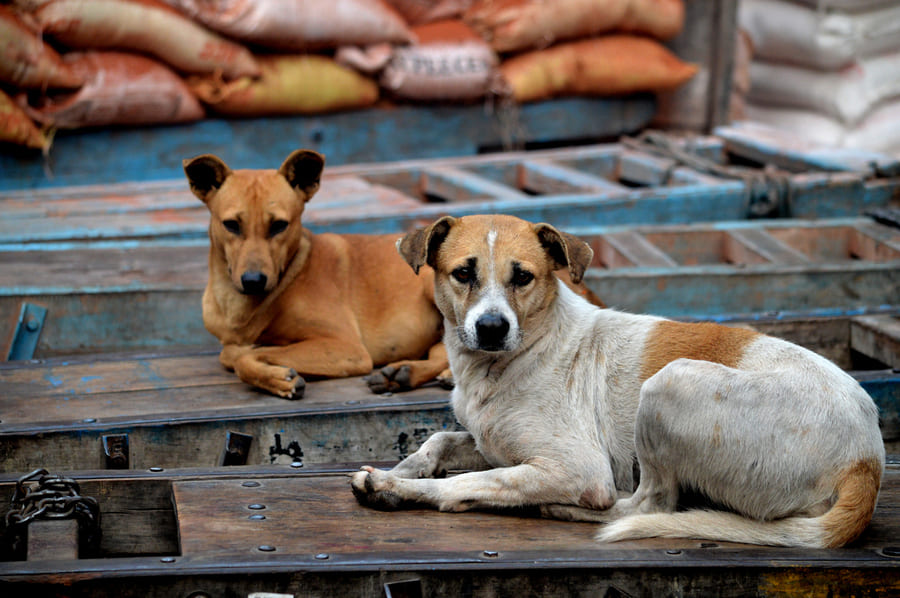
In India, this history has a specific texture. The Indian street dog – the desi dog, the Indie – is one of the oldest domesticated dog populations on earth. These animals have lived alongside Indian families for thousands of years, and they have always eaten Indian food.
Rice and dal. Fish and bones. Cooked meat. Chapati with a little ghee. Leftover sabzi. Eggs. Curd. This is what Indian dogs ate across generations, and it is what their digestive systems are calibrated for. The Indian climate, the Indian microbiome, the Indian diet — all of it shaped the biology of dogs that lived here.
This doesn’t mean every dog in India needs to eat rice and dal. It means that when we think about what dogs are built to eat, the answer in the Indian context is: real food. recognisable food.
The kind of food that has fed Indian dogs for millennia, not the kind invented in a factory in the last fifty years.
Where Modern Pet Food Went Wrong
The commercial pet food industry is roughly 150 years old. In that time, it has produced genuine innovations – understanding of specific nutrient requirements, improvements in food safety, the development of complete and balanced formulations. These things matter.
But the industry also went in a direction that has little to do with what dogs evolved to eat. Ultra-high-temperature processing that destroys naturally occurring nutrients, a far cry from the ancestral dog diet that has been wired into their DNA. Ingredient lists built around cheap fillers and by-products. Synthetic vitamins and minerals added back in because the processing stripped the natural ones out. Preservatives required because the product needs a two-year shelf life.
The result is a product that can keep a dog alive and technically meet minimum nutritional standards — but that bears almost no resemblance to food as any dog across history would have recognised it.
What the Ancestral Diet Actually Looks Like
An ancestral approach to dog feeding doesn’t require going back to the Stone Age. It doesn’t mean raw food only, or bones only, or any other rigid formula. What it means is grounding feeding decisions in real ingredients rather than industrial ones.
Concretely, this means:
Real proteins – chicken, mutton, fish, eggs. Not “hydrolysed poultry by-product meal.” Actual meat that you could identify by sight.
Digestible carbohydrates in appropriate quantities – rice, for example, has been part of the Indian dog diet for thousands of years. It’s easily digestible and a legitimate energy source. The problem with carbohydrates in commercial food isn’t carbohydrates themselves — it’s the quantity and quality. Sixty percent rice powder as a filler is not the same as cooked rice as part of a balanced meal.
Natural fats – ghee, coconut oil, the fat that comes with meat. These are the fats that have always been part of what dogs ate. They are not the same as the rendered fats used in commercial processing.
Food-based micronutrients– turmeric, which has natural anti-inflammatory properties your dog’s ancestors got from eating table food in Indian kitchens. Vegetables. Herbs. Things that carry nutrients in the form the body was designed to absorb.
This is the philosophy behind Mega Bowl’s meals. Every ingredient is something you could name. Every item on the list is food, not chemistry.
What This Means in Practice
Dog parents who switch to a native diet approach often describe a similar pattern. Within a few weeks, they notice changes: a coat that looks different, digestion that is more settled, energy that is more consistent. The dog eats with more enthusiasm. They seem, simply, better.
These aren’t placebo effects — the dog isn’t responding to the packaging or the story. They’re responding to the food itself. Real ingredients are more bioavailable. Real fats and proteins are processed by the body more efficiently. A diet that resembles what dogs evolved to eat produces outcomes that match.
The Question Worth Asking
The next time you look at what’s in your dog’s bowl, it’s worth asking a single question: would a dog across history have recognised this as food?
If the answer is yes — if it looks like meat, smells like food, is made from ingredients you could describe to a child — then you’re on the right track.
If the answer requires a chemistry degree to unpick, it might be worth thinking about what you’re actually feeding.
Dogs can’t ask for better. But when served natural dog food, they notice the difference.
100% Native Diet Meals
Mega Bowl has real proteins, digestible carbohydrates, natural fats. No fillers. No synthetic preservatives. No ingredients you’d need to look up.